Research/Stablecoins·Report
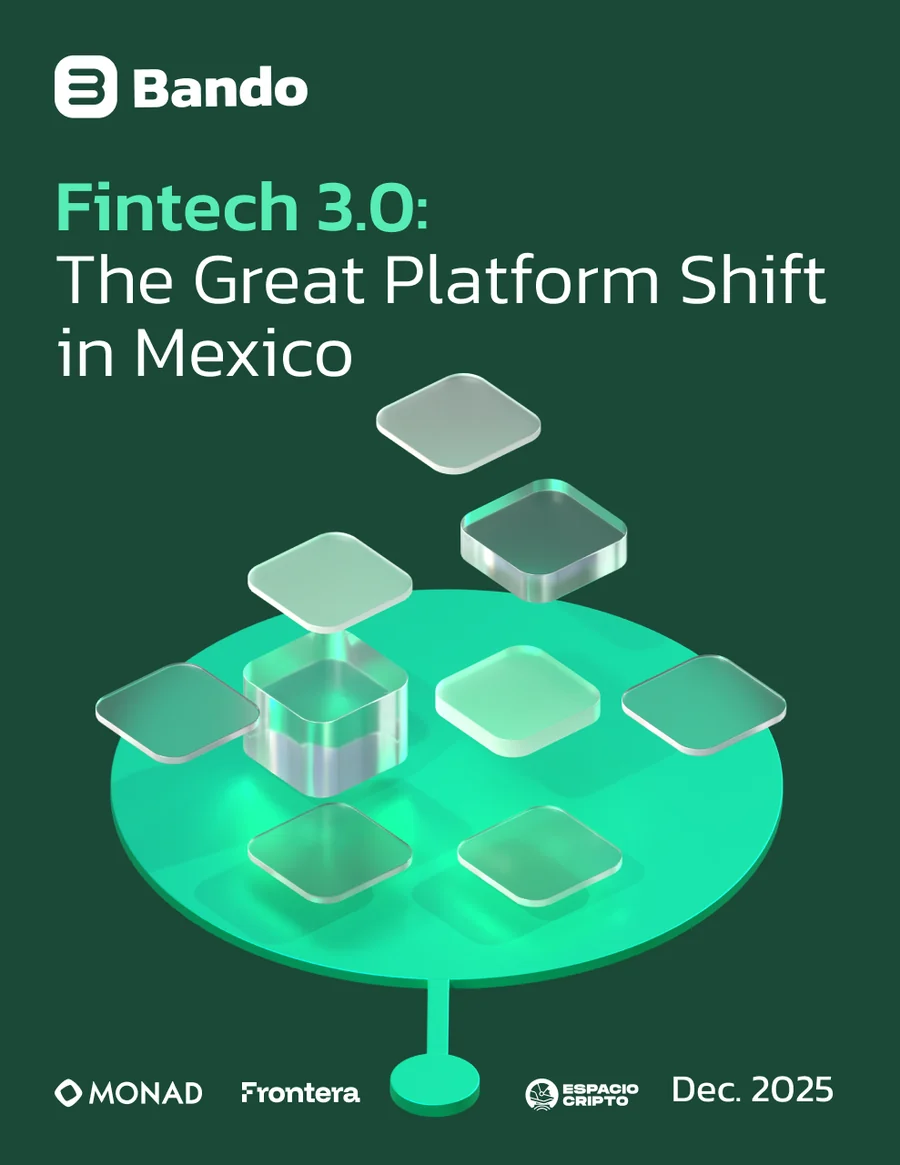
Fintech 3.0: The Great Platform Shift in Mexico
A comprehensive framework for understanding Fintech 3.0, the next technological platform shift transforming how financial products will be built in Mexico.
December 2025 · Published by Bando Abraham Cobos
 Julián González
Your report is ready.
Open it any time with the button below.
Still not opening? Open this page in your phone’s browser from the app’s menu, or write to julian@espaciocripto.io and we’ll send it to you.
Key messages
Fintech 3.0 is a historic technological platform shift.
Like electricity replacing candles or mobile replacing desktop computing, Fintech 3.0 represents an infrastructure replacement once a decisively better foundation becomes available. Programmable blockchain rails now outperform legacy banking systems across speed, cost and flexibility, making the transition unavoidable rather than optional.
Mexico is becoming Latin America’s most strategically important fintech market.
Mexico now hosts 1,104 fintech startups, up 8.3x since 2017, and in 2025 it surpassed Brazil in total VC dollars raised for the first time since 2012, with fintech absorbing the majority of that capital. This combination of ecosystem scale and capital concentration makes Mexico one of the world’s most primed markets for Fintech 3.0 adoption.
There is a structural funding gap driven by local risk aversion.
In the most exciting Fintech 3.0 companies, cap tables are dominated by international investors, with relatively few Mexican funds taking significant positions. Local capital’s hesitation to underwrite crypto-native infrastructure creates an opening for global investors willing to back the country’s next generation of financial winners.
Partnership, not vertical integration, is the winning execution model in Mexico.
Seventy-five percent of traditional finance institutions are either already collaborating with fintechs, in the process of doing so, or explicitly open to partnerships, giving Mexico the highest openness to collaboration in Latin America. This partnership-first culture makes a “build-with-partners” approach the most effective way to launch Fintech 3.0 products quickly while managing regulatory and technical risk.
Mexico’s strong peso and SPEI system create a uniquely favorable starting point.
Over the last decade the peso has been far more stable than other major Latin American currencies and it has appreciated about 10% against the dollar over the last five years, while SPEI has scaled to more than 4B instant, low-cost transfers per year. Instead of fleeing a collapsing unit of account or patching broken domestic rails, Mexican fintechs can focus on using Fintech 3.0 to upgrade the experience of a large, digital-first user base and make peso payments programmable across the apps people already use every day.
Fintech competition has shifted from acquisition to monetization and retention.
Fintech 2.0 neobanks won users with promotional, high-yield savings accounts often capped by low limits and funded as marketing spend rather than real investment products. That strategy worked during the acquisition phase, helping fintechs onboard a massive user base. More than 70M Mexicans, roughly 54% of the country’s 130M population, were using fintech services by 2024. In Fintech 3.0, however, durable advantage will come from sustainable yield sourced from transparent onchain assets and from richer product suites that monetize and retain this already-acquired audience over time, rather than relying on short-term incentives.
Regional champions are betting their future on Fintech 3.0.
Nubank, Revolut and Bitso are weaving stablecoins, onchain settlement and digital asset products into their core roadmaps, signaling that the next phase of their growth will be built on crypto-enabled rails. This shift from side experiments to strategic pillars makes clear that for Latin America’s biggest consumer fintechs, Fintech 3.0 capabilities are now prerequisites for long-term competitiveness.
Crypto and traditional finance are converging into unified, rail-agnostic experiences.
DolarApp’s and Bitso’s integration of U.S. equities show crypto-enabled companies expanding into traditional asset classes. As traditional fintechs move in the opposite direction, integrating Fintech 3.0-enabled products, the line between “crypto” and “traditional” finance is fading, leaving only better financial experiences for users.
Fintech 3.0 will turn companies into full financial operating systems.
Converging into unified, rail-agnostic experiences also means that the next generation of fintech winners will offer everything in one place: high-yield savings, dollar accounts, CETES, international bonds, stocks, crypto and emerging primitives like prediction markets. Users will grow accustomed to managing their entire financial lives inside a single app, while fragmented product offerings will increasingly feel incomplete.
Winners will combine Fintech 2.0 distribution and trust with Fintech 3.0 technical execution.
Mexico’s competitive field is coalescing into three groups: legacy Fintech 2.0 players, Fintech 2.0 companies upgrading their rails, and Fintech 3.0 startups. The companies most likely to win will be those that pair the brand, user base and regulatory strength of Fintech 2.0 with the infrastructure, speed and product intuition of Fintech 3.0, through deep collaboration between traditional and crypto-native teams.
Recommended
All research → Stablecoins·Report
Stablecoins: Rebuilding Finance for the Internet Age in Latin America
How stablecoins are rebuilding financial infrastructure across Latin America.
Abraham Cobos, Julián González·Nov 2026 Stablecoins·Article
Stablecoins and the American Techno-economic Conquest of the 21st Century
Stablecoins as an instrument of dollar dominance, and what it means for Latin America.
Julián González, Abraham Cobos·Aug 2025