Research/Stablecoins·Report
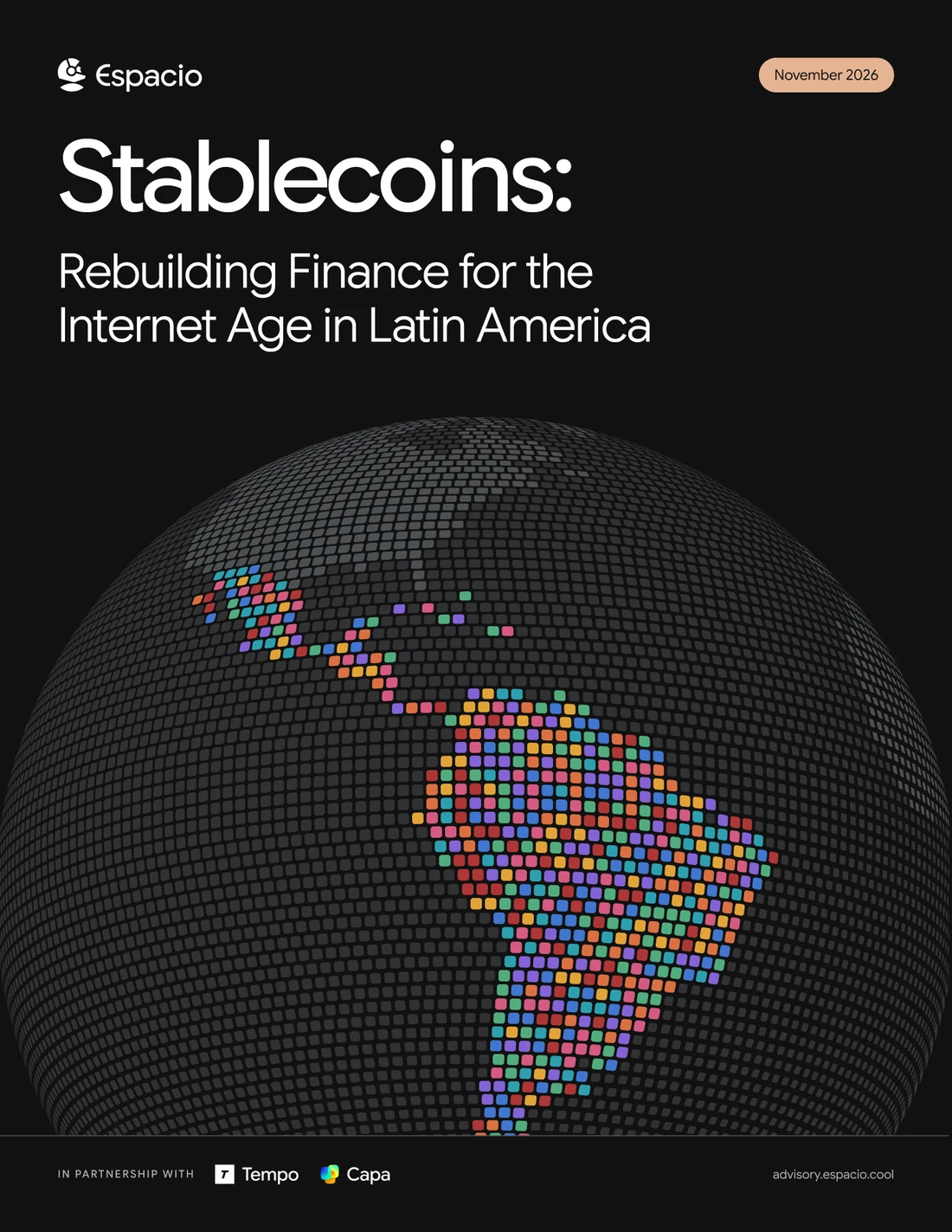
Stablecoins: Rebuilding Finance for the Internet Age in Latin America
How stablecoins are moving money onto the internet, and what that means for every company building financial products in Latin America.
November 2026 Abraham Cobos
 Julián González
Your report is ready.
Open it any time with the button below.
Still not opening? Open this page in your phone’s browser from the app’s menu, or write to julian@espaciocripto.io and we’ll send it to you.
Key messages
Money is following the path of the long-distance phone call.
Once voice became data, the international call faded into just a call. Stablecoins are doing the same for money by putting every balance on one shared ledger, where a payment settles as a single update both sides see at once. As money becomes internet-native, the international transfer, and many of the services built around correspondent banking, no longer have a reason to exist.
Five properties make internet money a better foundation for finance.
Stablecoins settle in seconds for a fraction of a cent, run every hour of the year, reach anyone with an internet connection and can be moved by software, removing the cost, delay, cut-off times, borders and rigidity built into traditional rails. For a company, this means a treasury can rebalance between subsidiaries in minutes, idle cash can earn yield until it is spent, and revenue collected abroad no longer sits in transit while the business finances the float.
Stablecoin supply is set to grow sixfold by 2030.
Even the most conservative published forecast, JPMorgan’s for 2028, implies supply rising by more than half from today’s $302B within two years. The central estimates for 2030 put it near $2T, growth that will come from the products companies are now building on internet money.
Latin America is one of the markets most primed for the shift.
The region’s largest economies already settle domestic payments in seconds through Pix, SPEI and similar systems, which leaves the dollar leg as the last slow segment to replace, while $173.7B in remittances and persistent inflation keep demand for that leg strong. Its largest institutions are already acting on this, with 21 global banks, including Santander and BBVA, committing to a jointly issued stablecoin, Nubank offering dollar accounts, and ARQ launching its own stablecoin.
Every financial function can now be assembled from components.
Issuing a stablecoin, holding customer assets and converting currency still require licenses, but each is now sold as a composable service through an API, which puts the full infrastructure within reach of any company willing to assemble it. Of the 184 companies on our map, 91% already operate beyond the category they lead with, and 147 of them offer money movement although only 21 lead with it.
Fintech as a set of distinct categories is dissolving.
Once adding a financial service costs little more than an integration, companies keep expanding until their offerings overlap, with nearly half the apps on our map already sharing the same core of money movement, cards and yield. Labels such as neobank and exchange now only record where a company started, as all consumer fintechs converge on the same customer.
Execution has become the moat.
When any feature can be integrated, advantage moves to what can’t be, whether that is the experience built on shared parts, the capital a company can commit behind its products, or years of proprietary data. What that asset is worth depends on which components a company adds around it, in what order and in which market, and on how quickly it moves before both the technology and its rivals pull ahead.
Recommended
All research → Stablecoins·Article
Stablecoins and the American Techno-economic Conquest of the 21st Century
Stablecoins as an instrument of dollar dominance, and what it means for Latin America.
Julián González, Abraham Cobos·Aug 2025 Stablecoins·Report
Fintech 3.0: The Great Platform Shift in Mexico
Why Mexico is primed for Fintech 3.0, and who is positioned to win it.
Abraham Cobos, Julián González·Dec 2025